RAG-LLM-知识库系统搭建
🧩 AI 知识库平台 · AI Knowledge Base Platform
简体中文 | English
一句话:独立设计并实现的生产级 AI 知识库平台,打通 RAG(真实语义嵌入 + 两阶段重排序)、ReAct 智能体、多模型 LLM、上下文记忆、知识图谱 五大能力;支持在 Web 端接入 / 切换大模型密钥并脱密保护,前后端分离 + 分层架构,Docker 一键部署。
本项目覆盖现代 AI 产品「文档摄取 → 向量检索 → 提示工程 → 智能体编排 → 多轮记忆 → 知识图谱 → 前端交互」的完整链路,是一个可运行、可测试、可扩展的工程作品集。为保证可演示性,嵌入内置离线确定性 Mock(零密钥即可跑通整条 RAG 链路),生产可一键切换为真实语义嵌入(bge-m3)。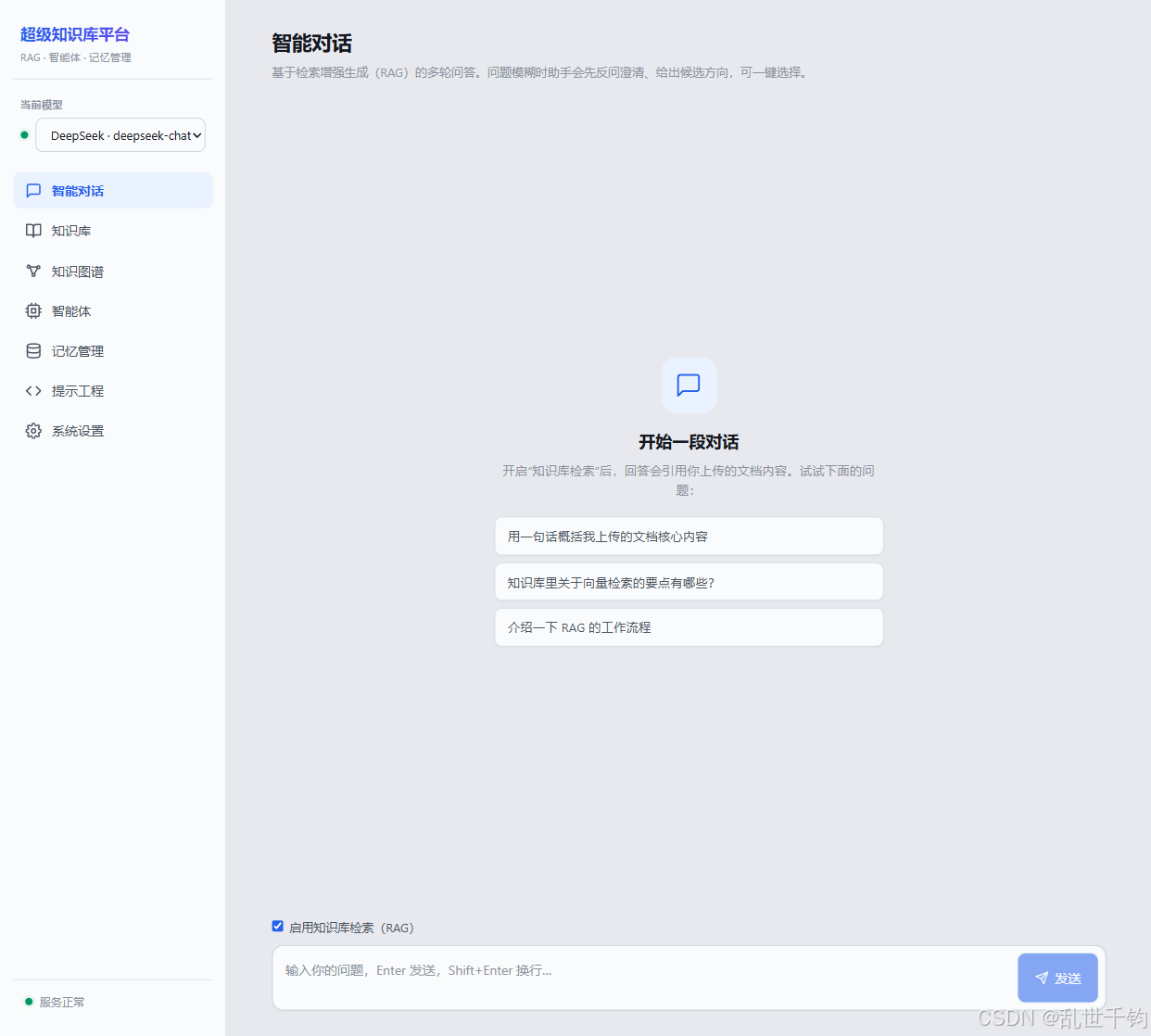
🌍 English Introduction
A production-grade AI Knowledge Base Platform, independently designed and built, integrating five core capabilities: RAG (real semantic embeddings + two-stage reranking), a ReAct agent, multi-provider LLMs, contextual memory, and a knowledge graph. LLM / embedding / reranker API keys can be configured and hot-switched from the Web UI with secret masking — keys never leave the page. Decoupled frontend/backend with a layered architecture, one-command Docker deployment.
It covers the full modern-AI pipeline — document ingestion → vector retrieval → prompt engineering → agent orchestration → multi-turn memory → knowledge graph → web interaction — as a runnable, testable and extensible engineering showcase. A built-in offline deterministic mock embedder lets the entire RAG chain run with zero keys (ideal for demos, CI and the 49 offline unit tests); switch to real semantic embeddings (bge-m3) for production.
🏛️ 系统架构 · Architecture
前后端分离 + 后端四层,依赖方向自上而下,核心能力层不感知上层。Decoupled frontend/backend with a four-layer backend; dependencies point downward and the core layer is framework-agnostic.
更详细的分层职责与模块深剖见
docs/system-overview.md。
✨ 核心功能
| 模块 | 能力 |
|---|---|
| RAG 检索增强 | 多格式文档(PDF/Word/TXT/Markdown)上传 → 解析 → 递归分块 → 向量化入库;两阶段语义检索(向量召回 + 重排精排);相关性阈值过滤,无据不编造 |
| 多模型 LLM | 统一抽象层封装 DeepSeek / 小米 MiMo(均兼容 OpenAI 协议);工厂模式 + 实例缓存;运行时一键切换;模板化提示工程;SSE 流式输出 |
| ReAct 智能体 | 复杂任务自动拆解(规划)→ 工具调用(计算器/时间/知识库检索)→ 结果汇总 → 自我反思迭代,全过程可视化 |
| 上下文记忆 | 多轮会话上下文维护;长期记忆持久化(主题 + 重要度 + TTL);跨会话历史检索;过期自动清理 |
| 知识图谱 | LLM 抽取「实体-关系-实体」三元组 → 并发限流 → 聚合去重加权 → cytoscape 可视化 |
| 系统设置 | Web 端配置 / 切换 LLM、嵌入、重排序密钥;脱敏展示;热重载免重启 |
| 前端界面 | 深色主题、响应式布局;SSE 流式打字机效果;检索来源展示;Agent 执行轨迹时间线;实时健康状态 |
🏗️ 技术栈
- 后端:Python 3.11 · FastAPI · Pydantic v2 · pydantic-settings · asyncio · openai SDK · httpx · 本地 numpy 向量库 · SQLite
- 模型 / 服务:DeepSeek · 小米 MiMo(OpenAI 兼容,可运行时切换);嵌入 bge-m3;重排序 bge-reranker-v2-m3
- 前端:React 18 · Vite 5 · TypeScript(strict)· 原生 SSE 流式解析 · cytoscape
- 部署:Docker · Docker Compose · Nginx(静态托管 + API 反向代理)
- 测试:pytest · pytest-asyncio(49 例,全离线)
架构、API、部署的详细文档见
docs/目录:
🚀 快速开始
方式一:Docker(推荐,一键启动)
前置:安装 Docker 与 Docker Compose。
# 在项目根目录执行
docker compose up -d --build
启动后访问:
- 前端界面:http://localhost
- 后端 API 文档(Swagger):http://localhost:8000/docs
- 健康检查:http://localhost:8000/api/health
嵌入与向量检索开箱即用(离线);对话/Agent 需在
backend/.env中填入 DeepSeek 或 MiMo 密钥,见下方「配置模型密钥」。
方式二:本地开发
需要本机安装 Python 3.11+ 与 Node.js 18+。
1) 启动后端
cd backend
python -m venv .venv
# Windows PowerShell
.venv\Scripts\Activate.ps1
# macOS / Linux
# source .venv/bin/activate

pip install -r requirements.txt
copy .env.example .env      # Windows;macOS/Linux 用 cp
uvicorn app.main:app --reload --port 8000
2) 启动前端(另开一个终端)
cd frontend
npm install
npm run dev
前端开发服务器默认运行在 http://localhost:5173,并通过 Vite 代理将 /api 转发到后端 http://localhost:8000。
🔑 配置模型密钥
编辑 backend/.env(从 .env.example 复制而来),填入 DeepSeek 或小米 MiMo 的密钥:
# 默认提供商:deepseek / mimo
DEFAULT_LLM_PROVIDER=deepseek

# DeepSeek(OpenAI 兼容)
DEEPSEEK_API_KEY=sk-xxxxxxxx

# 或小米 MiMo
MIMO_API_KEY=xxxxxxxx
重启后端即可。前端顶部的「模型选择器」会自动识别已配置密钥的提供商并允许运行时切换。
🧪 运行测试
cd backend
pip install -r requirements.txt   # 已包含 pytest / pytest-asyncio
pytest -v
测试覆盖核心模块(全部离线运行,无需 API Key 或外部服务):
test_embeddings.py:嵌入的确定性、归一化、语义相似度排序test_splitter.py:文本分块的大小约束与边界条件test_parsing.py:LLM 输出的健壮 JSON 抽取test_memory.py:会话生命周期、历史检索、长期记忆与 TTL 清理test_tools.py:Agent 工具(含计算器安全校验)与注册中心test_llm.py:OpenAI 兼容提供商(DeepSeek/MiMo)的构造校验 + 工厂的切换与缓存test_retriever.py:索引构建、语义检索、按文档删除、上下文拼接(使用内存版假向量库)test_vectorstore.py:本地 numpy 向量库的增删、相似度检索、元数据过滤与持久化
📁 项目结构
our-project/
├── backend/                    # FastAPI 后端
│   ├── app/
│   │   ├── main.py             # 应用入口(生命周期、CORS、异常、路由)
│   │   ├── config.py           # pydantic-settings 配置(离线嵌入默认开箱即用)
│   │   ├── api/                # 路由层:documents / chat / agent / memory / models
│   │   ├── core/               # 核心能力
│   │   │   ├── llm/            # LLM 抽象、各提供商、工厂、提示模板
│   │   │   ├── rag/            # 加载/分块/嵌入/向量库/检索器
│   │   │   ├── agent/          # 工具/规划/执行/反思
│   │   │   └── memory/         # SQLite 存储 + 记忆管理器
│   │   ├── services/          # 服务编排层(依赖容器 + 业务服务)
│   │   ├── models/            # Pydantic 请求/响应 Schema
│   │   └── utils/             # 日志、异常、解析工具
│   ├── tests/                 # pytest 测试
│   ├── requirements.txt
│   ├── Dockerfile
│   └── .env.example
├── frontend/                  # React + Vite + TS 前端
│   ├── src/
│   │   ├── App.tsx            # 根组件(导航、模型选择、健康状态)
│   │   ├── api/client.ts      # REST 客户端 + SSE 流式
│   │   ├── components/        # Chat/Documents/Agent/Memory/Prompt 面板
│   │   └── types.ts           # 与后端对齐的 TS 类型
│   ├── Dockerfile
│   └── nginx.conf
├── docs/                      # 架构 / API / 部署文档
└── docker-compose.yml         # 一键编排
💡 设计亮点
- 依赖倒置与组合根:所有子系统在
services/container.py统一装配,路由通过依赖注入获取,便于测试与替换实现。 - 离线可演示:
MockEmbedder(哈希词袋 + L2 归一化)+ 本地 numpy 向量库让整条 RAG 链路在零依赖、零密钥下也能真实运行;对话/Agent 填入 DeepSeek 或 MiMo 密钥即可启用。 - 嵌入与向量库解耦:自行计算嵌入并向本地向量库写入预计算向量,可自由切换嵌入实现。
- 健壮性:LLM 输出 JSON 的容错解析、Agent 规划失败的兜底计划、计算器工具的字符白名单防注入、全局异常处理器。
- 完整中文注释:所有模块均含函数说明、参数、返回值与关键逻辑解释。
项目链接:https://github.com/Chun556699/RAG-KnowledgeBase
📄 许可 · License
本项目基于 MIT License 开源,可自由使用、修改与商用,保留版权声明即可。
Licensed under the MIT License — free to use, modify and distribute with attribution.

欢迎加入DeepSeek 技术社区。在这里,你可以找到志同道合的朋友,共同探索AI技术的奥秘。
更多推荐
 16
16 0
0- 0


 已为社区贡献1条内容

所有评论(0)