【大模型面试】一文讲清楚50 道大模型核心面试题目及答案
今天看到一份文档《Top 50 LLM Interview Questions》,这份专为AI爱好者和面试专业人士精心打造的综合指南,汇编了50个核心面试问题,每个问题都配有详细的解答,融合了技术见解与实践案例,感觉非常有价值!
今天看到一份文档《Top 50 LLM Interview Questions》,这份专为AI爱好者和面试专业人士精心打造的综合指南,汇编了50个核心面试问题,每个问题都配有详细的解答,融合了技术见解与实践案例,感觉非常有价值!
我不是 AI 出身,也没有参加过类似的面试,但这份文档确实给我解答了一些疑惑,虽然有些问题还是看不太懂,但这就是我学习AI的动力,多看、多学,一定能学会的。
由于原文是英文,所以我用 Google Gemini 进行了全文翻译,分享给大家,一起学习。感谢作者 Hao Hoang
50 道大模型核心面试题目及答案
Question 1: What does tokenization entail, and why is it critical for LLMs?
问1:什么是词元化(Tokenization),为什么它对LLM至关重要?
Tokenization involves breaking down text into smaller units, or tokens, such as words, subwords, or characters. For example, “artificial” might be split into “art,” “ific,” and “ial.” This process is vital because LLMs process numerical representations of tokens, not raw text. Tokenization enables models to handle diverse languages, manage rare or unknown words, and optimize vocabulary size, enhancing computational efficiency and model performance.
词元化指将文本分解为更小的单元,即词元(token),如单词、子词或字符。 例如,“artificial”可能会被拆分为“art”、“ific”和“ial”。 这个过程至关重要,因为LLM处理的是词元的数值表示,而非原始文本。 词元化使模型能够处理多种语言,管理罕见或未知词汇,并优化词汇表大小,从而提高计算效率和模型性能。
Question 2: How does the attention mechanism function in transformer models?
问2:注意力机制(Attention Mechanism)在Transformer模型中如何运作?
The attention mechanism allows LLMs to weigh the importance of different tokens in a sequence when generating or interpreting text. It computes similarity scores between query, key, and value vectors, using operations like dot products, to focus on relevant tokens. For instance, in “The cat chased the mouse,” attention helps the model link “mouse” to “chased.” This mechanism improves context understanding, making transformers highly effective for NLP tasks.
在生成或解释文本时,注意力机制允许LLM权衡序列中不同词元的重要性。 它通过点积等运算计算查询(query)、键(key)和值(value)向量之间的相似度得分,从而聚焦于相关的词元。 例如,在句子“The cat chased the mouse”(猫追逐老鼠)中,注意力机制帮助模型将“mouse”(老鼠)与“chased”(追逐)联系起来。 该机制提升了对上下文的理解,使Transformer模型在自然语言处理(NLP)任务中极为高效。
Question 3: What is the context window in LLMs, and why does it matter?
问3:LLM中的上下文窗口(Context Window)是什么,它为什么重要?
The context window refers to the number of tokens an LLM can process at once, defining its “memory” for understanding or generating text. A larger window, like 32,000 tokens, allows the model to consider more context, improving coherence in tasks like summarization. However, it increases computational costs. Balancing window size with efficiency is crucial for practical LLM deployment.
上下文窗口指LLM一次能处理的词元数量,它定义了模型在理解或生成文本时的“记忆”范围。 一个更大的窗口,如32,000个词元,允许模型考虑更多的上下文,从而在摘要等任务中提高连贯性。 然而,这也会增加计算成本。 因此,在实际部署LLM时,平衡窗口大小与效率至关重要。
Question 4: What distinguishes LORA from QLORA in fine-tuning LLMs?
问4:在微调LLM方面,LORA和QLORA有何区别?
LORA (Low-Rank Adaptation) is a fine-tuning method that adds low-rank matrices to a models layers, enabling efficient adaptation with minimal memory overhead. QLORA extends this by applying quantization (e.g., 4-bit precision) to further reduce memory usage while maintaining accuracy. For example, QLORA can fine-tune a 70B-parameter model on a single GPU, making it ideal for resource-constrained environments.
LORA(Low-Rank Adaptation,低秩自适应)是一种微调方法,它通过向模型层中添加低秩矩阵,以极小的内存开销实现高效的模型适配。 QLORA在此基础上进一步应用了量化技术(如4位精度),在保持准确性的同时进一步减少内存使用。 例如,QLORA可以在单个GPU上微调一个700亿参数的模型,使其成为资源受限环境的理想选择。
Question 5: How does beam search improve text generation compared to greedy decoding?
问5:与贪心解码(Greedy Decoding)相比,束搜索(Beam Search)如何改进文本生成?
Beam search explores multiple word sequences during text generation, keeping the top k candidates (beams) at each step, unlike greedy decoding, which selects only the most probable word. This approach, with , for instance, ensures more coherent outputs by balancing probability and diversity, especially in tasks like machine translation or dialogue generation.
在文本生成过程中,束搜索会探索多个候选词序列,在每一步保留前k个最优候选(即“束”),而贪心解码仅选择最可能的一个词。 例如,当时,这种方法通过平衡概率和多样性,确保了输出结果更具连贯性,尤其适用于机器翻译或对话生成等任务。
Question 6: What role does temperature play in controlling LLM output?
问6:温度(Temperature)在控制LLM输出中扮演什么角色?
Temperature is a hyperparameter that adjusts the randomness of token selection in text generation. A low temperature (e.g., 0.3) favors high-probability tokens, producing predictable outputs. A high temperature (e.g., 1.5) increases diversity by flattening the probability distribution. Setting temperature to 0.8 often balances creativity and coherence for tasks like storytelling.
温度是一个超参数,用于调节文本生成过程中词元选择的随机性。 低温(如0.3)会倾向于选择高概率的词元,产生更可预测的输出。 高温(如1.5)则通过平滑概率分布来增加多样性。 对于故事创作等任务,将温度设置为0.8通常可以在创造性和连贯性之间取得良好平衡。
Question 7: What is masked language modeling, and how does it aid pretraining?
问7:什么是掩码语言建模(Masked Language Modeling),它如何辅助预训练?
Masked language modeling (MLM) involves hiding random tokens in a sequence and training the model to predict them based on context. Used in models like BERT, MLM fosters bidirectional understanding of language, enabling the model to grasp semantic relationships. This pretraining approach equips LLMs for tasks like sentiment analysis or question answering.
掩码语言建模(MLM)涉及在序列中随机隐藏一些词元,并训练模型根据上下文来预测它们。 MLM被用于像BERT这样的模型中,它促进了对语言的双向理解,使模型能够掌握语义关系。 这种预训练方法为LLM执行情感分析或问答等任务奠定了基础。
Question 8: What are sequence-to-sequence models, and where are they applied?
问8:什么是序列到序列(Seq2Seq)模型,它们应用于哪些领域?
Sequence-to-sequence (Seq2Seq) models transform an input sequence into an output sequence, often of different lengths. They consist of an encoder to process the input and a decoder to generate the output. Applications include machine translation (e.g., English to Spanish), text summarization, and chatbots, where variable-length inputs and outputs are common.
序列到序列(Seq2Seq)模型将一个输入序列转换为一个输出序列,两者长度通常不同。 它们由一个处理输入的编码器和一个生成输出的解码器组成。 其应用包括机器翻译(如英语到西班牙语)、文本摘要和聊天机器人等,这些场景普遍存在可变长度的输入和输出。
Question 9: How do autoregressive and masked models differ in LLM training?
问9:在LLM训练中,自回归模型(Autoregressive Models)和掩码模型(Masked Models)有何不同?
Autoregressive models, like GPT, predict tokens sequentially based on prior tokens, excelling in generative tasks such as text completion. Masked models, like BERT, predict masked tokens using bidirectional context, making them ideal for understanding tasks like classification. Their training objectives shape their strengths in generation versus comprehension.
自回归模型(如GPT)基于先前的词元顺序预测下一个词元,擅长文本补全等生成式任务。 掩码模型(如BERT)则利用双向上下文来预测被掩盖的词元,使其成为分类等理解型任务的理想选择。 它们的训练目标决定了各自在生成与理解方面的优势。
Question 10: What are embeddings, and how are they initialized in LLMs?
问10:什么是嵌入(Embeddings),它们在LLM中是如何初始化的?
Embeddings are dense vectors that represent tokens in a continuous space, capturing semantic and syntactic properties. They are often initialized randomly or with pretrained models like GloVe, then fine-tuned during training. For example, the embedding for “dog” might evolve to reflect its context in pet-related tasks, enhancing model accuracy.
嵌入是密集的向量表示,用于在连续空间中代表词元,捕捉其语义和句法属性。 它们通常被随机初始化,或使用如GloVe等预训练模型进行初始化,然后在训练过程中进行微调。 例如,“dog”(狗)的嵌入向量可能会在使用中不断演化,以反映其在宠物相关任务中的上下文,从而提高模型准确性。
Question 11: What is next sentence prediction, and how does it enhance LLMs?
问11:什么是下一句预测(Next Sentence Prediction),它如何增强LLM?
Next sentence prediction (NSP) trains models to determine if two sentences are consecutive or unrelated. During pretraining, models like BERT learn to classify 50% positive (sequential) and 50% negative (random) sentence pairs. NSP improves coherence in tasks like dialogue systems or document summarization by understanding sentence relationships.
下一句预测(NSP)训练模型判断两个句子是连续的还是不相关的。 在预训练期间,像BERT这样的模型学习对50%的正例(连续句子对)和50%的负例(随机句子对)进行分类。 通过理解句子间的关系,NSP能够提高对话系统或文档摘要等任务的连贯性。
Question 12: How do top-k and top-p sampling differ in text generation?
问12:在文本生成中,Top-k采样和Top-p采样有何不同?
Top-k sampling selects the k most probable tokens (e.g., ) for random sampling, ensuring controlled diversity. Top-p (nucleus) sampling chooses tokens whose cumulative probability exceeds a threshold p (e.g., 0.95), adapting to context. Top-p offers more flexibility, producing varied yet coherent outputs in creative writing.
Top-k采样从k个最可能的词元中进行随机抽样(例如k=20),确保了可控的多样性。 Top-p(核心)采样则选择累积概率超过阈值p(例如0.95)的词元集,从而能够根据上下文自适应地调整候选范围。 Top-p提供了更大的灵活性,能在创意写作中生成既多样又连贯的输出。
Question 13: Why is prompt engineering crucial for LLM performance?
问13:为什么提示工程(Prompt Engineering)对LLM性能至关重要?
Prompt engineering involves designing inputs to elicit desired LLM responses. A clear prompt, like “Summarize this article in 100 words,” improves output relevance compared to vague instructions. Its especially effective in zero-shot or few-shot settings, enabling LLMs to tackle tasks like translation or classification without extensive fine-tuning.
提示工程涉及设计输入内容以引导LLM产生期望的响应。 一个清晰的提示,如“将这篇文章总结在100字以内”,相比模糊的指令,更能提高输出的相关性。 它在零样本(zero-shot)或少样本(few-shot)场景中尤其有效,使LLM无需大量微调即可处理翻译或分类等任务。
Question 14: How can LLMs avoid catastrophic forgetting during fine-tuning?
问14:LLM在微调过程中如何避免灾难性遗忘(Catastrophic Forgetting)?
Catastrophic forgetting occurs when fine-tuning erases prior knowledge. Mitigation strategies include:
- Rehearsal: Mixing old and new data during training.
- Elastic Weight Consolidation: Prioritizing critical weights to preserve knowledge.
- Modular Architectures: Adding task-specific modules to avoid overwriting.
These methods ensure LLMs retain versatility across tasks.
灾难性遗忘指微调过程抹去了模型先前的知识。 缓解策略包括:
- 重放(Rehearsal): 在训练中混合新旧数据。
- 弹性权重固化(Elastic Weight Consolidation): 优先保护关键权重以保留知识。
- 模块化架构(Modular Architectures): 添加任务特定的模块以避免覆盖原有权重。
这些方法确保LLM在不同任务间保持其通用性。
Question 15: What is model distillation, and how does it benefit LLMs?
问15:什么是模型蒸馏(Model Distillation),它对LLM有何益处?
Model distillation trains a smaller “student” model to mimic a larger “teacher” models outputs, using soft probabilities rather than hard labels. This reduces memory and computational requirements, enabling deployment on devices like smartphones while retaining near-teacher performance, ideal for real-time applications.
模型蒸馏通过训练一个较小的“学生”模型来模仿一个较大的“教师”模型的输出,它使用的是软概率而非硬标签。 这减少了内存和计算需求,使得模型能够部署在智能手机等设备上,同时保持接近教师模型的性能,是实时应用的理想选择。
Question 16: How do LLMs manage out-of-vocabulary (OOV) words?
问16:LLM如何处理词汇表外(OOV)的单词?
LLMs use subword tokenization, like Byte-Pair Encoding (BPE), to break OOV words into known subword units. For instance, “cryptocurrency” might split into “crypto” and “currency.” This approach allows LLMs to process rare or new words, ensuring robust language understanding and generation.
LLM使用子词词元化方法,如字节对编码(BPE),将OOV单词分解为已知的子词单元。 例如,“cryptocurrency”(加密货币)可能会被拆分为“crypto”和“currency”。 这种方法使LLM能够处理罕见或新词,确保了稳健的语言理解和生成能力。
Question 17: How do transformers improve on traditional Seq2Seq models?
问17:Transformer模型相比传统Seq2Seq模型有何改进?
Transformers overcome Seq2Seq limitations by:
- Parallel Processing: Self-attention enables simultaneous token processing, unlike sequential RNNS.
- Long-Range Dependencies: Attention captures distant token relationships.
- Positional Encodings: These preserve sequence order.
These features enhance scalability and performance in tasks like translation.
Transformer通过以下方式克服了Seq2Seq模型的局限性:
- 并行处理(Parallel Processing): 自注意力机制支持同时处理所有词元,不同于序列化的RNN。
- 长距离依赖(Long-Range Dependencies): 注意力机制能捕捉远距离词元之间的关系。
- 位置编码(Positional Encodings): 这些编码保留了序列的顺序信息。
这些特性增强了模型在翻译等任务中的可扩展性和性能。
Question 18: What is overfitting, and how can it be mitigated in LLMS?
问18:什么是过拟合(Overfitting),在LLM中如何缓解?
Overfitting occurs when a model memorizes training data, failing to generalize. Mitigation includes:
- Regularization: L1/L2 penalties simplify models.
- Dropout: Randomly disables neurons during training.
- Early Stopping: Halts training when validation performance plateaus.
These techniques ensure robust generalization to unseen data.
过拟合指模型记住了训练数据,但无法泛化到新数据上。 缓解措施包括:
- 正则化(Regularization): L1/L2惩罚项可简化模型。
- 随机失活(Dropout): 在训练期间随机禁用神经元。
- 早停(Early Stopping): 当验证集性能不再提升时停止训练。
这些技术确保了模型对未见数据的稳健泛化能力。
Question 19: What are generative versus discriminative models in NLP?
问19:在NLP中,生成模型(Generative Models)和判别模型(Discriminative Models)有何区别?
Generative models, like GPT, model joint probabilities to create new data, such as text or images. Discriminative models, like BERT for classification, model conditional probabilities to distinguish classes, e.g., sentiment analysis. Generative models excel in creation, while discriminative models focus on accurate classification.
生成模型(如GPT)对联合概率进行建模以创建新数据,如文本或图像。 判别模型(如用于分类的BERT)则对条件概率进行建模以区分不同类别,例如情感分析。 生成模型擅长创造,而判别模型专注于准确分类。
Question 20: How does GPT-4 differ from GPT-3 in features and applications?
问20:GPT-4与GPT-3在功能和应用上有何不同?
GPT-4 surpasses GPT-3 with:
- Multimodal Input: Processes text and images.
- Larger Context: Handles up to 25,000 tokens versus GPT-3s 4,096.
- Enhanced Accuracy: Reduces factual errors through better fine-tuning.
These improvements expand its use in visual question answering and complex dialogues.
GPT-4在以下方面超越了GPT-3:
- 多模态输入(Multimodal Input): 能够处理文本和图像。
- 更大的上下文(Larger Context): 可处理多达25,000个词元,而GPT-3为4,096个。
- 更高的准确性(Enhanced Accuracy): 通过更好的微调减少了事实性错误。
这些改进扩展了其在视觉问答和复杂对话等领域的应用。
Question 21: What are positional encodings, and why are they used?
问21:什么是位置编码(Positional Encodings),为什么要使用它们?
Positional encodings add sequence order information to transformer inputs, as self-attention lacks inherent order awareness. Using sinusoidal functions or learned vectors, they ensure tokens like “king” and “crown” are interpreted correctly based on position, critical for tasks like translation.
由于自注意力机制本身不具备顺序感知能力,位置编码向Transformer的输入中添加了序列顺序信息。 通过使用正弦函数或学习的向量,它们确保了像“king”(国王)和“crown”(王冠)这样的词元能根据其位置被正确解释,这对于翻译等任务至关重要。
Question 22: What is multi-head attention, and how does it enhance LLMs?
问22:什么是多头注意力(Multi-head Attention),它如何增强LLM?
Multi-head attention splits queries, keys, and values into multiple subspaces, allowing the model to focus on different aspects of the input simultaneously. For example, in a sentence, one head might focus on syntax, another on semantics. This improves the models ability to capture complex patterns.
多头注意力将查询、键和值分割到多个子空间中,允许模型同时关注输入的不同方面。 例如,在句子中,一个头可能关注句法,另一个头可能关注语义。 这提高了模型捕捉复杂模式的能力。
Question 23: How is the softmax function applied in attention mechanisms?
问23:Softmax函数在注意力机制中是如何应用的?
The softmax function normalizes attention scores into a probability distribution:
In attention, it converts raw similarity scores (from query-key dot products) into weights, emphasizing relevant tokens. This ensures the model focuses on contextually important parts of the input.
Softmax函数将注意力得分归一化为一个概率分布:
在注意力机制中,它将原始的相似度得分(来自查询-键的点积)转换为权重,从而突出相关的词元。 这确保了模型能聚焦于输入中上下文重要的部分。
Question 24: How does the dot product contribute to self-attention?
问24:点积(Dot Product)在自注意力机制中有何贡献?
In self-attention, the dot product between query (Q) and key (K) vectors computes similarity scores:
High scores indicate relevant tokens. While efficient, its quadratic complexity for long sequences has spurred research into sparse attention alternatives.
在自注意力机制中,查询(Q)和键(K)向量之间的点积用于计算相似度得分:
高分表示词元之间相关性强。 虽然这种方法很高效,但其对于长序列的二次方复杂度()也催生了对稀疏注意力等替代方案的研究。
Question 25: Why is cross-entropy loss used in language modeling?
问25:为什么在语言建模中使用交叉熵损失(Cross-entropy Loss)?
Cross-entropy loss measures the divergence between predicted and true token probabilities:
It penalizes incorrect predictions, encouraging accurate token selection. In language modeling, it ensures the model assigns high probabilities to correct next tokens, optimizing performance.
交叉熵损失衡量了预测的词元概率与真实概率分布之间的差异:
它惩罚不正确的预测,鼓励模型进行准确的词元选择。 在语言建模中,它确保模型为正确的下一个词元分配高概率,从而优化性能。
Question 26: How are gradients computed for embeddings in LLMs?
问26:在LLM中,嵌入的梯度(Gradients for Embeddings)是如何计算的?
Gradients for embeddings are computed using the chain rule during backpropagation:
These gradients adjust embedding vectors to minimize loss, refining their semantic representations for better task performance.
嵌入的梯度是在反向传播过程中使用链式法则计算的:
这些梯度会调整嵌入向量以最小化损失,从而优化它们的语义表示,以获得更好的任务性能。
Question 27: What is the Jacobian matrixs role in transformer backpropagation?
问27:雅可比矩阵(Jacobian Matrix)在Transformer的反向传播中扮演什么角色?
The Jacobian matrix captures partial derivatives of outputs with respect to inputs. In transformers, it helps compute gradients for multidimensional outputs, ensuring accurate updates to weights and embeddings during backpropagation, critical for optimizing complex models.
雅可比矩阵捕捉了输出相对于输入的偏导数。 在Transformer中,它帮助计算多维输出的梯度,确保在反向传播期间对权重和嵌入进行准确更新,这对于优化复杂模型至关重要。
Question 28: How do eigenvalues and eigenvectors relate to dimensionality reduction?
问28:特征值(Eigenvalues)和特征向量(Eigenvectors)与降维有何关系?
Eigenvectors define principal directions in data, and eigenvalues indicate their variance. In techniques like PCA, selecting eigenvectors with high eigenvalues reduces dimensionality while retaining most variance, enabling efficient data representation for LLMs input processing.
特征向量定义了数据中的主方向,而特征值表示了这些方向上的方差大小。 在像主成分分析(PCA)这样的技术中,选择具有高特征值的特征向量可以在保留大部分方差的同时降低维度,从而实现对LLM输入数据的有效表示。
Question 29: What is KL divergence, and how is it used in LLMS?
问29:什么是KL散度(KL Divergence),它在LLM中如何使用?
KL divergence quantifies the difference between two probability distributions:
In LLMs, it evaluates how closely model predictions match true distributions, guiding fine-tuning to improve output quality and alignment with target data.
KL散度量化了两个概率分布之间的差异:
在LLM中,它用于评估模型预测与真实分布的匹配程度,指导微调过程以提高输出质量和与目标数据的一致性。
Question 30: What is the derivative of the ReLU function, and why is it significant?
问30:ReLU函数的导数是什么,为什么它很重要?
The ReLU function, , has a derivative:
f’(x) = {1 if x > 0, 0 otherwise}
Its sparsity and non-linearity prevent vanishing gradients, making ReLU computationally efficient and widely used in LLMs for robust training.
ReLU函数 的导数是:
它的稀疏性和非线性有助于防止梯度消失问题,使得ReLU计算高效,并在LLM中被广泛用于实现稳健的训练。
Question 31: How does the chain rule apply to gradient descent in LLMs?
问31:链式法则(Chain Rule)如何应用于LLM的梯度下降中?
The chain rule computes derivatives of composite functions:
In gradient descent, it enables backpropagation to calculate gradients layer by layer, updating parameters to minimize loss efficiently across deep LLM architectures.
链式法则用于计算复合函数的导数:
在梯度下降中,它使反向传播能够逐层计算梯度,从而高效地更新参数以在深度LLM架构中最小化损失。
Question 32: How are attention scores calculated in transformers?
问32:在Transformer中,注意力分数(Attention Scores)是如何计算的?
Attention scores are computed as:
Attention(Q, K, V) = softmax()V
The scaled dot product measures token relevance, and softmax normalizes scores to focus on key tokens, enhancing context-aware generation in tasks like summarization.
注意力分数的计算公式如下:
Attention(Q, K, V) = softmax()V
缩放点积衡量了词元的相关性,而Softmax函数将分数归一化,以聚焦于关键的词元,从而在摘要等任务中增强上下文感知的生成能力。
Question 33: How does Gemini optimize multimodal LLM training?
问33:Gemini模型如何优化多模态LLM的训练?
Gemini enhances efficiency via:
- Unified Architecture: Combines text and image processing for parameter efficiency.
- Advanced Attention: Improves cross-modal learning stability.
- Data Efficiency: Uses self-supervised techniques to reduce labeled data needs.
These features make Gemini more stable and scalable than models like GPT-4.
Gemini通过以下方式提升效率:
- 统一架构(Unified Architecture): 结合文本和图像处理,实现参数高效。
- 先进的注意力机制(Advanced Attention): 改善跨模态学习的稳定性。
- 数据效率(Data Efficiency): 使用自监督技术减少对标注数据的需求。
这些特性使得Gemini比GPT-4等模型更稳定、更具可扩展性。
Question 34: What types of foundation models exist?
问34:存在哪些类型的基础模型(Foundation Models)?
Foundation models include:
- Language Models: BERT, GPT-4 for text tasks.
- Vision Models: ResNet for image classification.
- Generative Models: DALL-E for content creation.
- Multimodal Models: CLIP for text-image tasks.
These models leverage broad pretraining for diverse applications.
基础模型包括:
- 语言模型(Language Models): BERT, GPT-4,用于文本任务。
- 视觉模型(Vision Models): ResNet,用于图像分类。
- 生成模型(Generative Models): DALL-E,用于内容创作。
- 多模态模型(Multimodal Models): CLIP,用于文本-图像任务。
这些模型利用广泛的预训练知识服务于多样化的应用。
Question 35: How does PEFT mitigate catastrophic forgetting?
问35:PEFT如何缓解灾难性遗忘?
Parameter-Efficient Fine-Tuning (PEFT) updates only a small subset of parameters, freezing the rest to preserve pretrained knowledge. Techniques like LoRA ensure LLMs adapt to new tasks without losing core capabilities, maintaining performance across domains.
参数高效微调(Parameter-Efficient Fine-Tuning, PEFT)仅更新一小部分参数,并冻结其余参数以保留预训练知识。 像LoRA这样的技术确保LLM在适应新任务的同时不会丢失核心能力,从而在各个领域保持性能。
Question 36: What are the steps in Retrieval-Augmented Generation (RAG)?
问36:检索增强生成(RAG)的步骤是什么?
RAG involves:
- Retrieval: Fetching relevant documents using query embeddings.
- Ranking: Sorting documents by relevance.
- Generation: Using retrieved context to generate accurate responses.
RAG enhances factual accuracy in tasks like question answering.
RAG包括:
- 检索(Retrieval): 使用查询嵌入获取相关文档。
- 排序(Ranking): 按相关性对文档进行排序。
- 生成(Generation): 使用检索到的上下文生成准确的回答。
RAG在问答等任务中增强了事实的准确性。
Question 37: How does Mixture of Experts (MoE) enhance LLM scalability?
问37:混合专家模型(Mixture of Experts, MoE)如何增强LLM的可扩展性?
MoE uses a gating function to activate specific expert sub-networks per input, reducing computational load. For example, only 10% of a models parameters might be used per query, enabling billion-parameter models to operate efficiently while maintaining high performance.
MoE使用一个门控函数(gating function)为每个输入激活特定的专家子网络,从而减少计算负荷。 例如,每次查询可能只使用模型10%的参数,这使得数十亿参数的模型能够高效运行,同时保持高性能。
Question 38: What is Chain-of-Thought (CoT) prompting, and how does it aid reasoning?
问38:什么是思维链(Chain-of-Thought, CoT)提示,它如何辅助推理?
CoT prompting guides LLMs to solve problems step-by-step, mimicking human reasoning. For example, in math problems, it breaks down calculations into logical steps, improving accuracy and interpretability in complex tasks like logical inference or multi-step queries.
CoT提示引导LLM像人类一样分步骤解决问题。 例如,在数学问题中,它将计算分解为多个逻辑步骤,从而在逻辑推断或多步查询等复杂任务中提高准确性和可解释性。
Question 39: How do discriminative and generative AI differ?
问39:判别式AI(Discriminative AI)和生成式AI(Generative AI)有何不同?
Discriminative AI, like sentiment classifiers, predicts labels based on input features, modeling conditional probabilities. Generative AI, like GPT, creates new data by modeling joint probabilities, suitable for tasks like text or image generation, offering creative flexibility.
判别式AI,如情感分类器,根据输入特征预测标签,它建模的是条件概率。 生成式AI,如GPT,通过建模联合概率来创建新数据,适用于文本或图像生成等任务,提供了创造性的灵活性。
Question 40: How does knowledge graph integration improve LLMs?
问40:知识图谱(Knowledge Graph)集成如何改进LLM?
Knowledge graphs provide structured, factual data, enhancing LLMs by:
- Reducing Hallucinations: Verifying facts against the graph.
- Improving Reasoning: Leveraging entity relationships.
- Enhancing Context: Offering structured context for better responses.
This is valuable for question answering and entity recognition.
知识图谱提供结构化的事实数据,通过以下方式增强LLM:
- 减少幻觉(Reducing Hallucinations): 对照图谱验证事实。
- 改进推理(Improving Reasoning): 利用实体间的关系。
- 增强上下文(Enhancing Context): 提供结构化上下文以生成更好的响应。
这在问答和实体识别等任务中非常有价值。
Question 41: What is zero-shot learning, and how do LLMs implement it?
问41:什么是零样本学习(Zero-shot Learning),LLM如何实现它?
Zero-shot learning allows LLMs to perform untrained tasks using general knowledge from pretraining. For example, prompted with “Classify this review as positive or negative,” an LLM can infer sentiment without task-specific data, showcasing its versatility.
零样本学习允许LLM利用预训练获得的通用知识来执行未经专门训练的任务。 例如,当给出提示“将这篇评论分类为正面或负面”时,LLM可以无需任何任务特定的数据就能推断出情感,展示了其通用性。
Question 42: How does Adaptive Softmax optimize LLMs?
问42:自适应Softmax(Adaptive Softmax)如何优化LLM?
Adaptive Softmax groups words by frequency, reducing computations for rare words. This lowers the cost of handling large vocabularies, speeding up training and inference while maintaining accuracy, especially in resource-limited settings.
自适应Softmax按词频将单词分组,减少了对罕见词的计算量。 这降低了处理大词汇表的成本,在保持准确性的同时加快了训练和推理速度,尤其适用于资源有限的场景。
Question 43: How do transformers address the vanishing gradient problem?
问43:Transformer模型如何解决梯度消失问题?
Transformers mitigate vanishing gradients via:
- Self-Attention: Avoiding sequential dependencies.
- Residual Connections: Allowing direct gradient flow.
- Layer Normalization: Stabilizing updates.
These ensure effective training of deep models, unlike RNNs.
Transformer通过以下方式缓解梯度消失问题:
- 自注意力(Self-Attention): 避免了序列依赖。
- 残差连接(Residual Connections): 允许梯度直接流动。
- 层归一化(Layer Normalization): 稳定更新过程。
这些机制确保了深度模型的有效训练,与RNN不同。
Question 44: What is few-shot learning, and what are its benefits?
问44:什么是少样本学习(Few-shot Learning),它有哪些好处?
Few-shot learning enables LLMs to perform tasks with minimal examples, leveraging pretrained knowledge. Benefits include reduced data needs, faster adaptation, and cost efficiency, making it ideal for niche tasks like specialized text classification.
少样本学习利用预训练知识,使LLM只需极少的示例即可执行任务。 其好处包括减少数据需求、加快模型适配速度和提高成本效益,使其成为专业文本分类等小众任务的理想选择。
Question 45: How would you fix an LLM generating biased or incorrect outputs?
问45:你将如何修复一个生成有偏见或不正确输出的LLM?
To address biased or incorrect outputs:
- Analyze Patterns: Identify bias sources in data or prompts.
- Enhance Data: Use balanced datasets and debiasing techniques.
- Fine-Tune: Retrain with curated data or adversarial methods.
These steps improve fairness and accuracy.
要解决有偏见或不正确的输出:
- 分析模式(Analyze Patterns): 识别数据或提示中的偏见来源。
- 优化数据(Enhance Data): 使用平衡的数据集和去偏见技术。
- 微调(Fine-Tune): 使用精心筛选的数据或对抗性方法进行重新训练。
这些步骤可以提高模型的公平性和准确性。
Question 46: How do encoders and decoders differ in transformers?
问46:在Transformer中,编码器(Encoders)和解码器(Decoders)有何不同?
Encoders process input sequences into abstract representations, capturing context. Decoders generate outputs, using encoder outputs and prior tokens. In translation, the encoder understands the source, and the decoder produces the target language, enabling effective Seq2Seq tasks.
编码器处理输入序列,将其转换为捕捉上下文的抽象表示。 解码器则利用编码器的输出和先前生成的词元来生成输出。 在翻译任务中,编码器理解源语言,解码器生成目标语言,从而实现高效的Seq2Seq任务。
Question 47: How do LLMs differ from traditional statistical language models?
问47:LLM与传统的统计语言模型有何不同?
LLMs use transformer architectures, massive datasets, and unsupervised pretraining, unlike statistical models (e.g., N-grams) that rely on simpler, supervised methods. LLMs handle long-range dependencies, contextual embeddings, and diverse tasks, but require significant computational resources.
LLM使用Transformer架构、海量数据集和无监督预训练,而统计模型(如N-grams)则依赖于更简单、有监督的方法。 LLM能够处理长距离依赖、上下文嵌入和多样化的任务,但需要大量的计算资源。
Question 48: What is a hyperparameter, and why is it important?
问48:什么是超参数(Hyperparameter),为什么它很重要?
Hyperparameters are preset values, like learning rate or batch size, that control model training. They influence convergence and performance; for example, a high learning rate may cause instability. Tuning hyperparameters optimizes LLM efficiency and accuracy.
超参数是预设的、控制模型训练过程的值,如学习率或批量大小。 它们影响模型的收敛和性能;例如,过高的学习率可能导致训练不稳定。 调优超参数可以优化LLM的效率和准确性。
Question 49: What defines a Large Language Model (LLM)?
问49:如何定义大型语言模型(LLM)?
LLMs are AI systems trained on vast text corpora to understand and generate human-like language. With billions of parameters, they excel in tasks like translation, summarization, and question answering, leveraging contextual learning for broad applicability.
LLM是在海量文本语料库上训练的人工智能系统,能够理解和生成类似人类的语言。 它们拥有数十亿级的参数,擅长翻译、摘要和问答等任务,利用上下文学习能力实现了广泛的适用性。
Question 50: What challenges do LLMs face in deployment?
问50:LLM在部署中面临哪些挑战?
LLM challenges include:
- Resource Intensity: High computational demands.
- Bias: Risk of perpetuating training data biases.
- Interpretability: Complex models are hard to explain.
- Privacy: Potential data security concerns.
Addressing these ensures ethical and effective LLM use.
LLM面临的挑战包括:
- 资源密集(Resource Intensity): 高昂的计算需求。
- 偏见(Bias): 存在延续训练数据中偏见的风险。
- 可解释性(Interpretability): 复杂的模型难以解释。
- 隐私(Privacy): 潜在的数据安全问题。
解决这些挑战是确保LLM合乎道德且有效应用的关键。
如何学习大模型 AI ?
由于新岗位的生产效率,要优于被取代岗位的生产效率,所以实际上整个社会的生产效率是提升的。
但是具体到个人,只能说是:
“最先掌握AI的人,将会比较晚掌握AI的人有竞争优势”。
这句话,放在计算机、互联网、移动互联网的开局时期,都是一样的道理。
我在一线互联网企业工作十余年里,指导过不少同行后辈。帮助很多人得到了学习和成长。
我意识到有很多经验和知识值得分享给大家,也可以通过我们的能力和经验解答大家在人工智能学习中的很多困惑,所以在工作繁忙的情况下还是坚持各种整理和分享。但苦于知识传播途径有限,很多互联网行业朋友无法获得正确的资料得到学习提升,故此将并将重要的AI大模型资料包括AI大模型入门学习思维导图、精品AI大模型学习书籍手册、视频教程、实战学习等录播视频免费分享出来。
这份完整版的大模型 AI 学习资料已经上传CSDN,朋友们如果需要可以微信扫描下方CSDN官方认证二维码免费领取【保证100%免费】

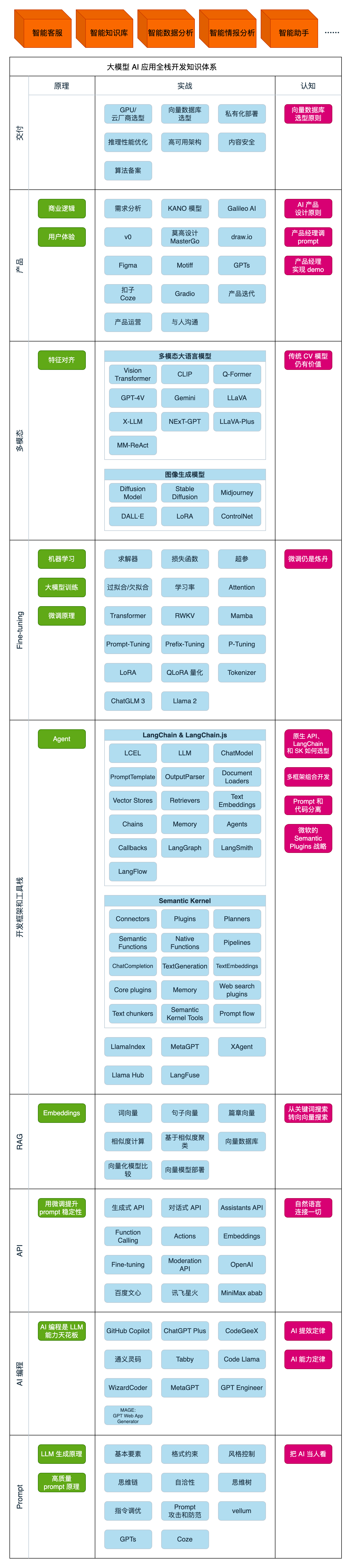
第一阶段(10天):初阶应用
该阶段让大家对大模型 AI有一个最前沿的认识,对大模型 AI 的理解超过 95% 的人,可以在相关讨论时发表高级、不跟风、又接地气的见解,别人只会和 AI 聊天,而你能调教 AI,并能用代码将大模型和业务衔接。
- 大模型 AI 能干什么?
- 大模型是怎样获得「智能」的?
- 用好 AI 的核心心法
- 大模型应用业务架构
- 大模型应用技术架构
- 代码示例:向 GPT-3.5 灌入新知识
- 提示工程的意义和核心思想
- Prompt 典型构成
- 指令调优方法论
- 思维链和思维树
- Prompt 攻击和防范
- …
第二阶段(30天):高阶应用
该阶段我们正式进入大模型 AI 进阶实战学习,学会构造私有知识库,扩展 AI 的能力。快速开发一个完整的基于 agent 对话机器人。掌握功能最强的大模型开发框架,抓住最新的技术进展,适合 Python 和 JavaScript 程序员。
- 为什么要做 RAG
- 搭建一个简单的 ChatPDF
- 检索的基础概念
- 什么是向量表示(Embeddings)
- 向量数据库与向量检索
- 基于向量检索的 RAG
- 搭建 RAG 系统的扩展知识
- 混合检索与 RAG-Fusion 简介
- 向量模型本地部署
- …
第三阶段(30天):模型训练
恭喜你,如果学到这里,你基本可以找到一份大模型 AI相关的工作,自己也能训练 GPT 了!通过微调,训练自己的垂直大模型,能独立训练开源多模态大模型,掌握更多技术方案。
到此为止,大概2个月的时间。你已经成为了一名“AI小子”。那么你还想往下探索吗?
- 为什么要做 RAG
- 什么是模型
- 什么是模型训练
- 求解器 & 损失函数简介
- 小实验2:手写一个简单的神经网络并训练它
- 什么是训练/预训练/微调/轻量化微调
- Transformer结构简介
- 轻量化微调
- 实验数据集的构建
- …
第四阶段(20天):商业闭环
对全球大模型从性能、吞吐量、成本等方面有一定的认知,可以在云端和本地等多种环境下部署大模型,找到适合自己的项目/创业方向,做一名被 AI 武装的产品经理。
- 硬件选型
- 带你了解全球大模型
- 使用国产大模型服务
- 搭建 OpenAI 代理
- 热身:基于阿里云 PAI 部署 Stable Diffusion
- 在本地计算机运行大模型
- 大模型的私有化部署
- 基于 vLLM 部署大模型
- 案例:如何优雅地在阿里云私有部署开源大模型
- 部署一套开源 LLM 项目
- 内容安全
- 互联网信息服务算法备案
- …
学习是一个过程,只要学习就会有挑战。天道酬勤,你越努力,就会成为越优秀的自己。
如果你能在15天内完成所有的任务,那你堪称天才。然而,如果你能完成 60-70% 的内容,你就已经开始具备成为一名大模型 AI 的正确特征了。
这份完整版的大模型 AI 学习资料已经上传CSDN,朋友们如果需要可以微信扫描下方CSDN官方认证二维码免费领取【保证100%免费】

欢迎加入DeepSeek 技术社区。在这里,你可以找到志同道合的朋友,共同探索AI技术的奥秘。
更多推荐

 4
4 0
0- 0


 已为社区贡献142条内容

所有评论(0)